History of Sarawak Maritime Industry
From boats built under coconut trees in Telok Selalo to a multi-million ringgit industry: how Sibu became the heartland of Malaysian shipbuilding.
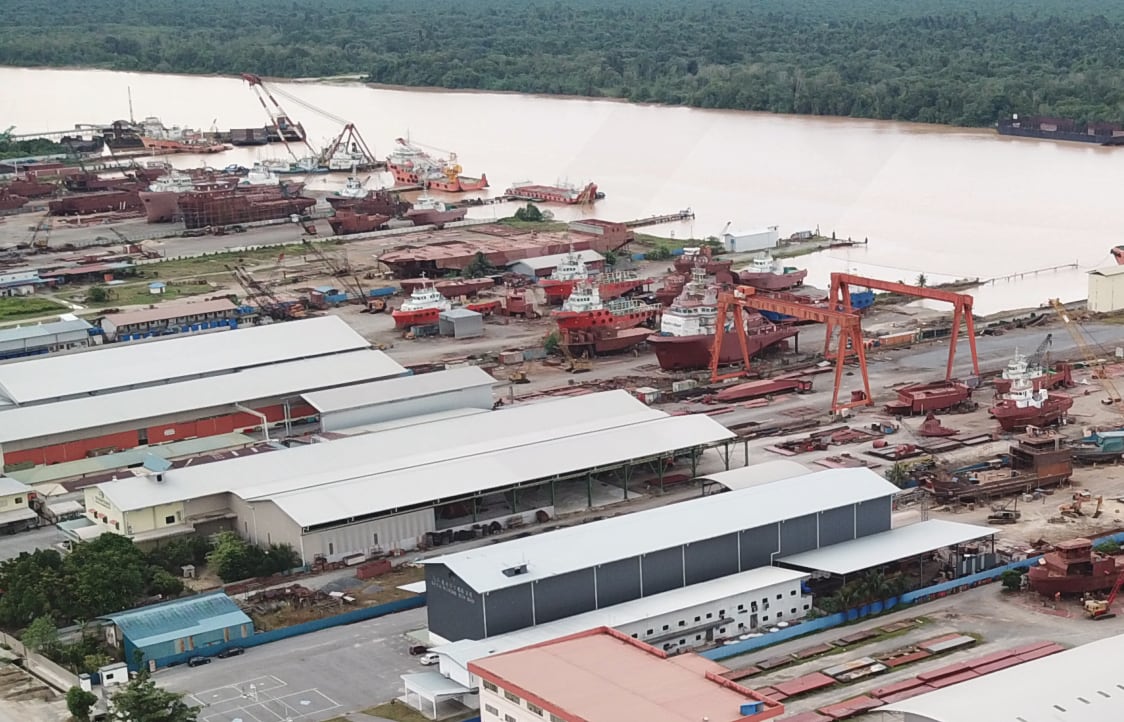
An article by Dr. Renco Yong, Executive Director of Gimhwak Shipyard Sdn. Bhd., for the Book of Sarawak – Maritime Industry.
SIBU: The shipbuilding and ship repairs (SBSR) industry has been contributing immensely to Sarawak's economy and trade, owing to the region's topography of multiple rivers and coasts.
According to statistics, the industry generated RM357 million worth of exports in 2017, and RM279 million in 2018, exporting many types of vessel including to Indonesia, Australia, Singapore, and the United Arab Emirates (UAE).
Despite travel restrictions and lockdowns during the COVID-19 pandemic, the industry has exported vessels worth RM260 million in 2020, RM345 million in 2021, and RM339 million in 2022, a testament to the high skills and capabilities of our local shipbuilders.
The marine industry plays a crucial role in supporting Malaysia's global trade, with 90 percent of world trade conducted through sea transport.
The government is committed to developing national technology through research and development and strengthening industrial sectors.
According to our industrial observation, more than 100 shipyards, big or small, operate within Sarawak, making it a vital growth area under the Post-Covid Development Strategy (PCDS) 2030 for Sarawak's aspirations to become a high-income economy by 2030.
They specialise in building and repairing small to medium-sized vessels such as tugboats, offshore support vessels (OSVs), barges, anchor handlers, and passenger boats.
With all these considered, Sibu could rightly claim to be the 'heartland of the shipbuilding and ship repairs industry in Malaysia'.
The history of SBSR began with the establishment of Brooke Dockyard - Kuching in 1912 by the White Rajah of Sarawak, the historical birthplace of shipbuilding but the industry is mostly concentrated in Sibu pioneered by early settlers who were mostly enterprising Foochows.
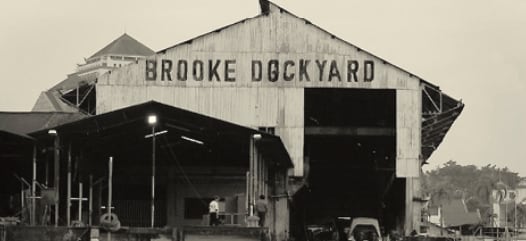 Brooke Dockyard, Kuching.
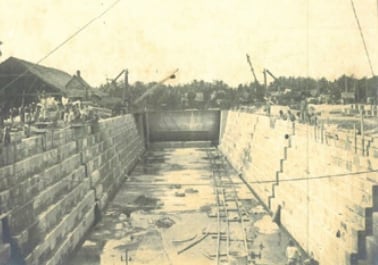 The dry dock at Brooke Dockyard.


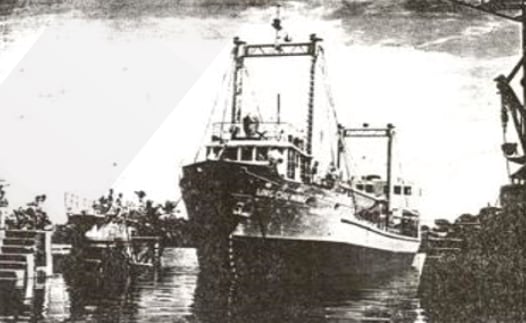
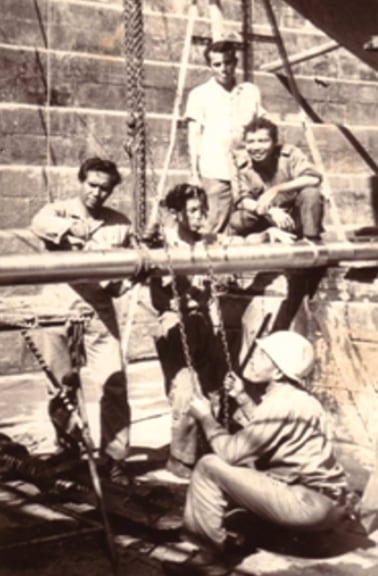 Archive photographs, Brooke Dockyard.
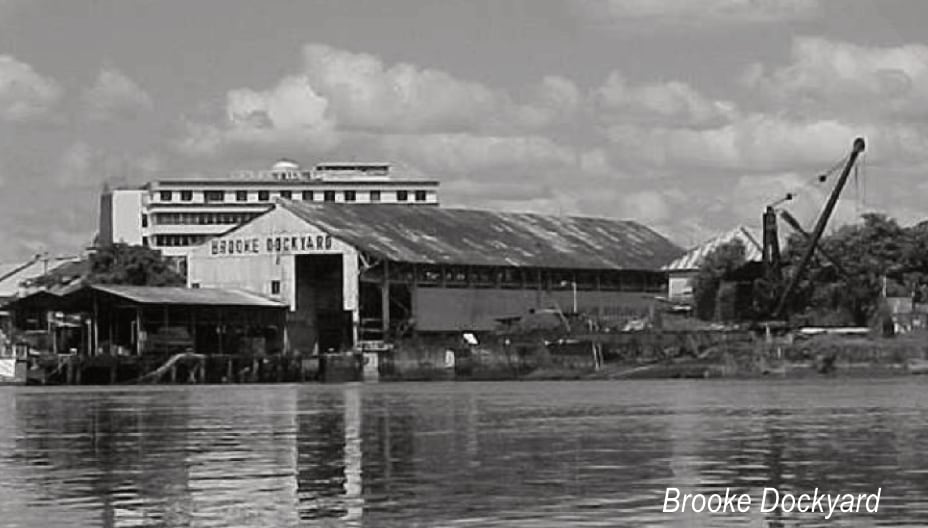 Brooke Dockyard.
In the 1930s, the shipbuilding industry kicked off in Sibu, building motor launches for riverine and coastal navigation as well as constructing vessels to support the timber industry.
Later, more sophisticated vessels were built for offshore and gas activities in Sarawak. In 1974, the Sibu Shipyards Association (SSA) was established, consisting of seven shipyards that operated in Sibu.
The SBSR industry in Sibu will continue to play a vital role in the economic development of Sarawak. The SSA has become the link between the shipbuilding industry players and government agencies, especially the Ministry of International Trade, Industry, Industrial Terminal and Entrepreneur Development, the MITI (Federal Ministry of International Trade and Industry), and MIDA (Malaysian Investment Development Authority).
The shipbuilding in Sibu, which began in 1935, was also the year when the Foochow settlers, led to Sarawak by Wong Nai Siong.
Hardened and enterprised Foochow men, who traveled to the remote shores of Sarawak, immediately saw the potential of shipbuilding in Sibu.
Since it is located at the confluence of the Igan River and the Rejang River, the longest river in Malaysia, Sibu is not only an ideal place for shipbuilding but also needed boats, and many of them.
The fact that infrastructure facilities were grossly underdeveloped and that the main means of transportation was the river gave a group of pioneers the faith and the impetus to venture into this great potential business opportunity.
Centrally located in the state of Sarawak, Sibu is the main town in the vast Rejang Basin. With the interiors accessible only by boats, it was only logical that the demand for better and faster boats was always there.
Even today, apart from the sporadic flights by national airlines, to towns such as Belaga (the last urban frontier before the Bakun Dam), express boats still ferry locals to their remote destinations.
With hardly any experience in boat building and shipbuilding, the group started their business by building small wooden boats for Sibu's many small and winding waterways.
From 1935 to 1940, the group was contented with building paddle boats with pointed ends at Telok Selalo, an hour's boat ride from Sibu town. There were no shipyards and no workshops. The builders just worked under coconut trees to which their boats were tied.
Clients would approach the builders and tell them the sizes of the boats they wanted or the number of people they should carry. The builders relied on simple common sense and perseverance.
After building a boat, they would study its performance and compare it with others - from where the shipbuilding industry here emerged through trials and error efforts.
But unfortunately, before the industry could develop further, the first world Japanese-war planes zoomed over the skies of Sarawak and cast their dark shadows on all and sundry.
Fearing for their lives, the group fled into the humid jungles and abandoned their boats. As soon as the Second World War ended in 1945, the group picked up where they left off and moved to Sungai Sadit, which was closer to Sibu town, and began to build bigger boats for carrying goods.
Such boats were fitted with outboard engines of between 50 and 100 horsepower. Later, the builders began to make fishing boats, called "kotak" (meaning box in the Malay language) for the sea-faring Heng Hua community.
Encouraged by their success, the builders set up their first shipyard in 1947 and named it Kiong Sing Shipyard. From there on, there was no turning back for the pioneer shipbuilders. As business prospered, the operations expanded, and the inevitable happened as more and more Chinese settlers began to set up their own shipyards.
In 1954, the second shipyard named after Kiong Tai was set up at Tanjung Maling and followed five years later by Ngie Lee Dockyard. Apart from building ships, Ngie Lee also looked into repairs and was, the first to have a slipway.
Before that, ships could only be repaired when the tide went out. Now boats could be repaired for leaks without worrying about rising waters. With Ngie Lee, shipbuilding in Sibu took its next step forward.
Good business sense or perhaps keen competition saw the shipbuilders coming together in 1961 to discuss a merger. But it failed through and only Sibu Shipyard and Kiong Sing Shipyard came out of the talks as one. Renamed Far East Shipyard Company Limited in 1961, it was a merger that survived even today.
In the 1960s there were about five different shipyards, mostly based at Sungai Antu, a tributary of the Igan River. Sungai Antu, the first industrial zone in Sibu, attracted shipbuilders with its space and facilities provided by the then colonial government.
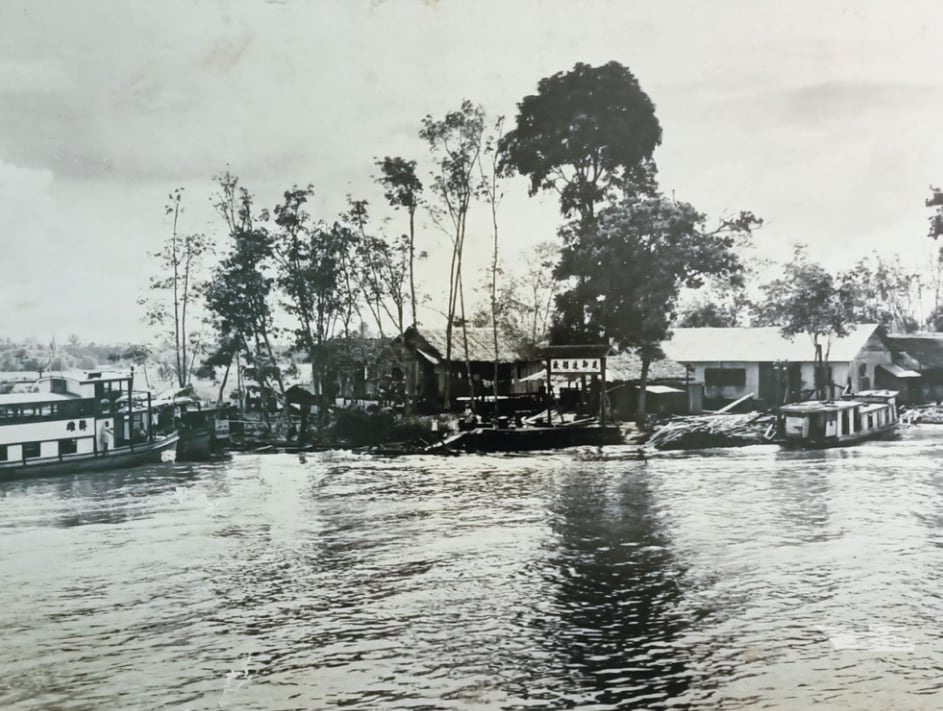
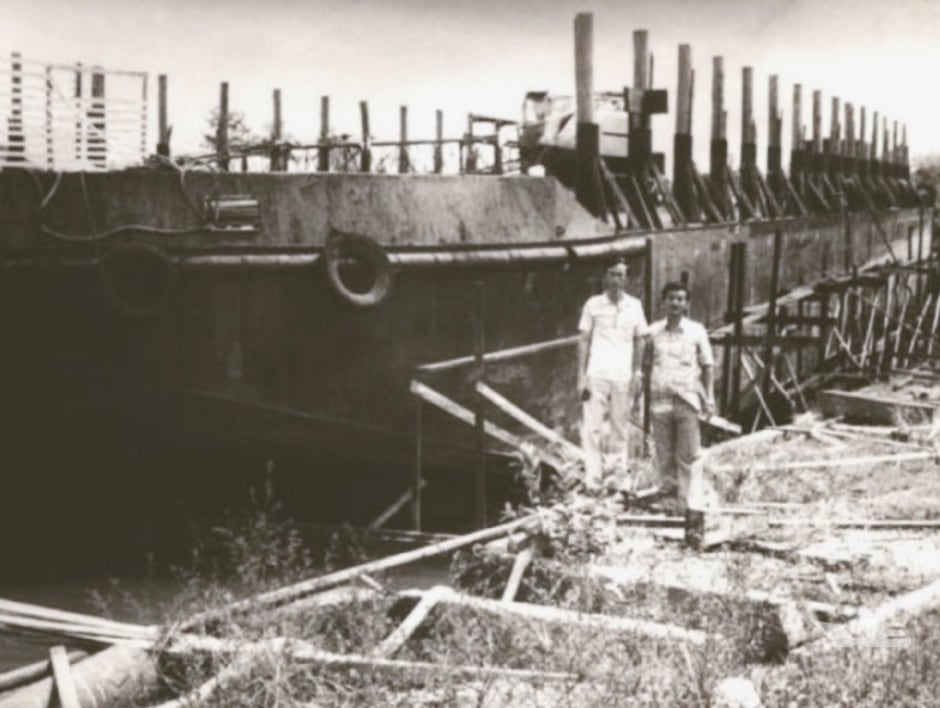 Far East Shipyard in 1961.
As the decade came to an end, the shipbuilding industry was suddenly hit by a crisis of sorts. The idea of steel hull boats, which had been a mere whisper, became a stark reality. Shipyards wondered and pondered how steel hull boats or ships could stay afloat.
After seeing the first steel hull boat with their own eyes, the pioneer shipbuilders here realized that their days would be numbered if they did not change and adapt. Because of the simple need to survive, they began experimenting with steel.
To their delight and relief, the steel hull boats proved to be more buoyant and could travel at greater speed. Without any drawings, they built steel hull boats the only way they could - with sheer gut. Clients put in verbal orders and they turned these into boats.
By the early 70s, the metamorphosis of the shipyards was almost complete. With the transformation, shipbuilding here took another step - perhaps most important in its history - towards modernization. The possibilities were mind-boggling, to say the least. The shipbuilders themselves were awed by the beauty, streamline qualities, and speed which such boats offered.
Suddenly, journeys up and down the mighty Rejang River were no longer dull; long and arduous. The new boats also reduced the journey from Sibu to Kuching. Instead of 12 hours, the trip took just four hours. Gleaming express boats began to dominate the scene and monopolised riverine travels, causing waves that were not in their favor. The boats also became faster and lighter.
Amidst such development, the government, alarmed by the cries of frustration from those residing by the river banks over the problem of soil erosion, came up with rulings to curb the speed of such boats. Such regulations did not hinder the industry as there were loopholes to be exploited.
While the government ruled that no boats should be fitted with engines whose maximum cruising speed exceeded 350 horsepower, many wily owners painted the figure 349 on their engines and sped happily along the length and breadth of the many rivers in Sarawak.
The timber boom in Sarawak in the 70s also helped boost the shipbuilding industry. Speedboats and express boats were needed to ferry executives and workers of timber companies to and from timber camps while tugboats and barges were needed to transport heavy logging machinery to the camps and timber logs from the camps to the ports.
It was the heyday of the shipbuilding industry. People had money and are willing to spend. Sibu boomed because of the timber industry and the tycoons it produced. Fortunately for the town, many tycoons were wise enough to diversify and today, the town remains vibrant as it continues to play its role as the state's financial powerhouse.
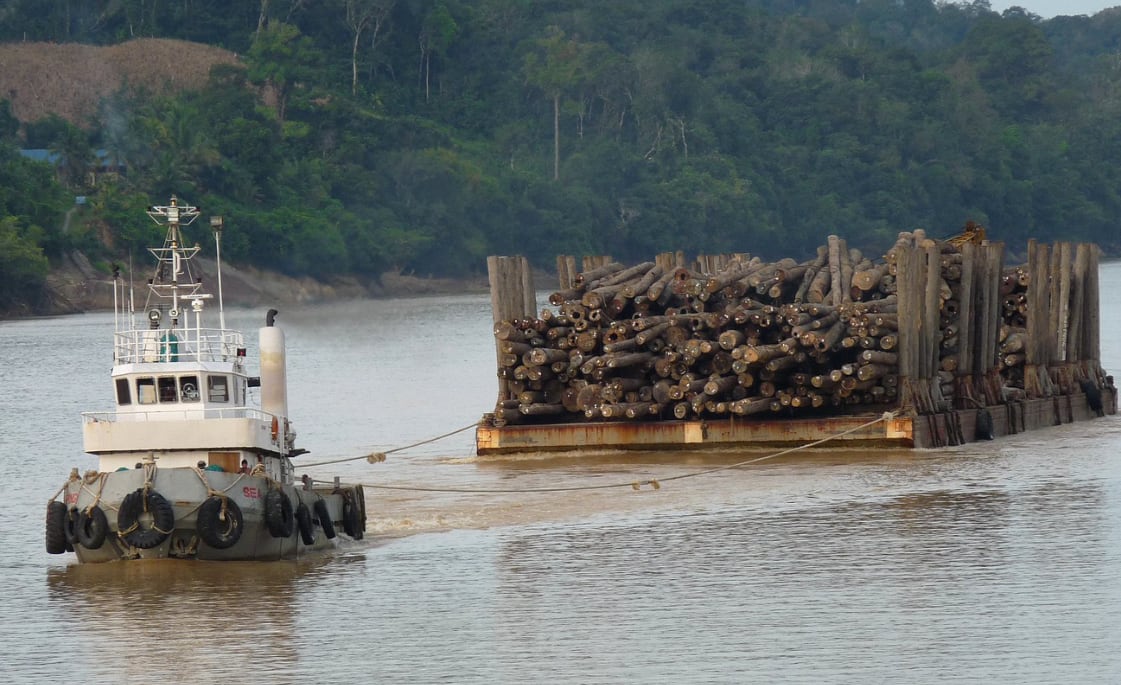 A tugboat towing a barge of timber logs.
After the timber industry went into decline in the mid-80s, shipbuilders realized the need to build even better boats to cater to clients outside the state's timber industry. Spurred on again by the need to survive, the industry took the next bold step into a new era by building boats for the international market.
Though few in number, naval architects began playing a role, especially from the 1980s onwards, in putting onto paper designs which would meet international standards. Soon, there were new designs for ships and boats. Some shipyards began to build ocean-going vessels although most specialized in either tugboats or high-speed express boats. These changes marked another significant step towards the maturing and development of the industry.
From the days when boats were built under coconut trees, shipbuilding in Sibu has now developed into a multi-million ringgit industry, providing boats of international standards for export to foreign countries.
Sibu can take pride in having an organised shipbuilding network and an array of supporting services, while the industry continues to place increasing emphasis on the need for a more skilled labor force. Members of the shipbuilding association can build well over 100 vessels annually, of which 50 percent are for the export market.
The Sibu shipyards today.
However, the industry is still left to develop almost on its own accord and to adapt to the market forces. Such development is not without its pitfalls. The growth of the shipbuilding industry suffers from a combination of image problems and lack of coordination. This has led to several, albeit limited, attempts by small-scale shipbuilders to cooperate among themselves and upgrade the industry to a larger scale in order to secure bigger contracts.
Sarawak's market is still considered relatively small for the shipbuilders. The contracts offered are diverse, ranging from the building of tugboats, trawlers, express boats, speedboats, and cargo boats of less than 1000 dead-weight tonnes to the construction of supertankers and specially fitted ships and high-tech ocean-going vessels for specialist clients such as Petronas and Shell, which are beyond the capacity of most shipyards in Sarawak.
On the other end of the scale, many shipbuilders are competing for small jobs. The stiff competition has resulted in small profit margins for many small-scale shipbuilders. Besides this, small-scale shipbuilders have to face the high costs of imported materials and substantial investment capital.
In order to create its niche in the global market and harness its potential to the fullest, the industry needs to acquire the latest technology and attract enough highly skilled manpower into its shipyards. Human resources and technology are critical aspects of the shipbuilding business and must not be overlooked.
Specialized courses such as marine engineering, naval architecture, and technology are prerequisites to inculcate interest in shipbuilding among the younger generation. Such a measure will contribute towards expanding the pool of skilled and qualified manpower in the industry.
References
- Timber ship: flickr.com/photos/peamasher/5686518097
- Far East black and white 2: facebook.com/photo/?fbid=317196667793169
- Far East black and white: facebook.com/photo/?fbid=317196644459838
- Oil & Gas: themalaysianreserve.com, 25 February 2021
- Brooke Dockyard: The history of Brooke Dockyard
- Brooke Dockyard 45: brookedockyard.com/about
- Sibu Shipyards Association 30th Anniversary Magazine, pages 37 - 45
More from the journal
All posts →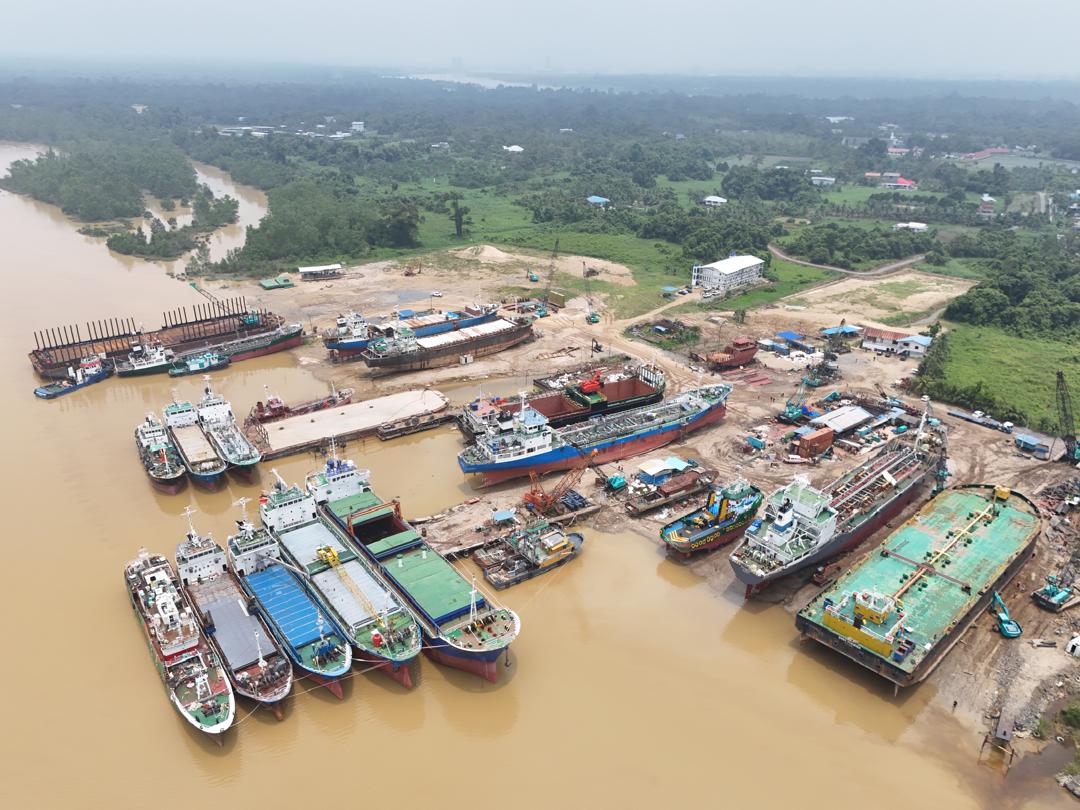 Article
From Timber and Charcoal to Steel Hulls: Why I Came Home to Build Ships on the Rajang
Sibu, the shipbuilding hub of Malaysia.
 Article
The Story of the Name I Chose and the Identity I Built
Renco or King.
 Article
Sibu: The heartland of Malaysia’s shipbuilding industry
Sarawak Tribune profiles the Yong family and how a charcoal and river-transport business grew into Gimhwak Group.